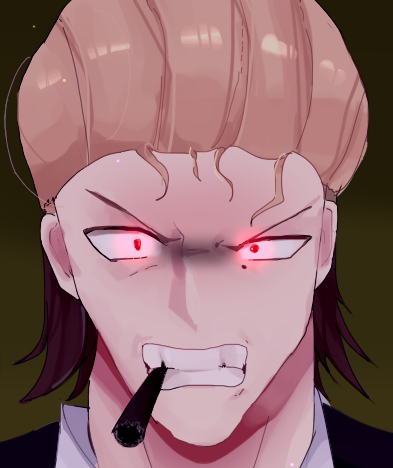
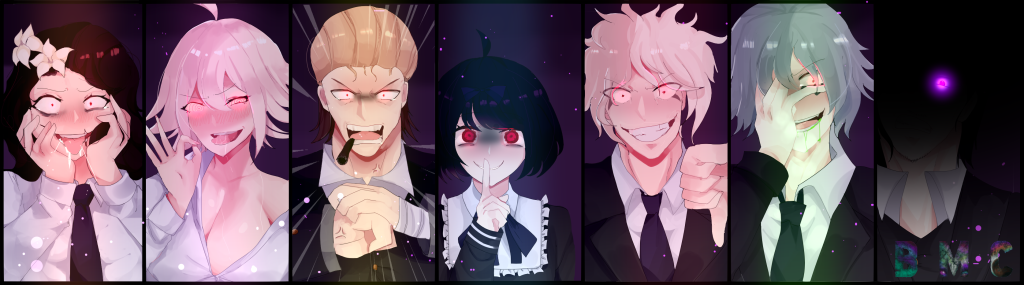
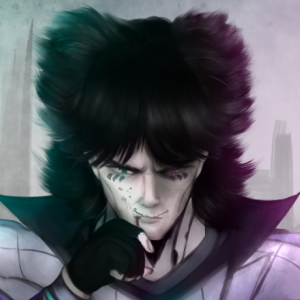
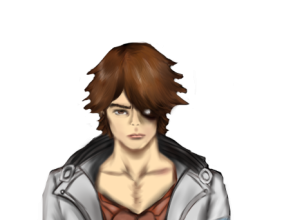
Ankhut Cessau, “Collector of All,” is one of Legion Realm’s Magnificent Seven. A well-organized and efficient mob leader, he is responsible for managing cargo and resources for Legion Realm. A former member of a gang organization, Ankhut’s ambition for success is his lifeblood, keeping both himself and those under him in check. He is regarded as a valuable asset due to his power, something he himself views as a curse. He serves as part of a cargo-hunting unit that replicates artificial Nosoimones through an AI program. Driven to put an end to the Obsidian Maidens, Ankhut assisted Scar during his reign in Legion Realm.
– Personality –
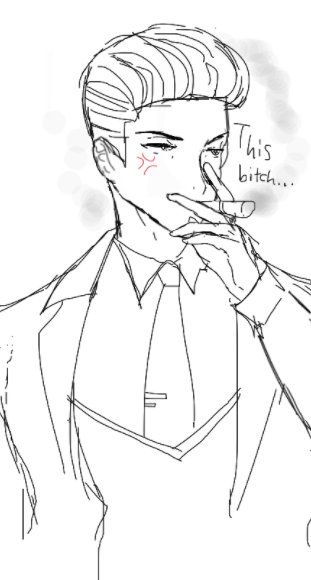
Ankhut is a confident yet pragmatic mob boss obsessed with achieving a sense of absolute security where he can never again be unprepared or at the mercy of others. To him, control is not ambition but protection, something forged in response to a world that once left him with nothing. He operates through calculated opportunism, using underhanded methods when necessary, but always within a self-imposed logic of efficiency and survival rather than impulse. He maintains an intense sense of structure in how he treats others and the world around him. Authority is expressed through ritual rather than chaos: the elderly are treated as respected seniors, obedience is formalized through repeated conduct, and even his own posture and restraint are deliberate acts of control. He carries a hard exterior paired with a quiet, internally organized mindset, remaining composed under pressure and acting decisively only when outcomes are certain. Punishment, in his system, is never emotional, it is correction, designed to realign behavior into something sustainable and predictable.
Ankhut’s moral framework is built around reputation and consistency. He respects those who keep promises even under penalty, endure punishment without breaking, and accept public accountability without contradiction. In his eyes, trust is not earned through loyalty alone but through the ability to remain unchanged under pressure. His decisions are evaluated through layered calculation, profit, long-term consequence, structural risk, and stability, always filtered through practicality rather than sentiment. However, beneath this controlled exterior lies persistent insecurity. Despite his accumulated authority, Ankhut carries the belief that he will never truly have enough to be safe. His early life of deprivation did not simply create ambition—it created dependency on accumulation as emotional defense. Because of this, he attaches identity to possession itself; his luxuries are not symbols of wealth, but proof that he is no longer disposable. Any insult toward them is perceived not as critique, but as an attack on the fragile stability he has built from nothing.
This need for structure extends into emotional interaction. Situations that lack clear hierarchy or transactional meaning, particularly casual intimacy or flirtation, cause hesitation in him. Without defined rules or exchange, he becomes uncertain, revealing a rare fracture in his otherwise rigid composure. In these moments, control cannot be applied cleanly, and so he defaults to restraint rather than engagement. In private, his habits reflect the same logic of classification and value judgment. He gravitates toward simple, “pure” foods like fresh watermelon, associating them with clarity and uncontaminated worth, while rejecting fried fast food as careless consumption, things that decay in meaning as quickly as they are made. Even preference, to him, is filtered through structure.
Ankhut’s obsession with glory manifests as accumulation and preservation. He constantly seeks greater power, at times betraying allies in pursuit of more secure ownership over resources or influence, and even allowing his own body to fossilize through stolen mass as a form of self-preservation through acquisition. He collects body parts, trophies, and memories of those he has killed, maintaining an extensive archive-like collection. To him, each piece is not mere spoils, but a “gem”—a fragment of permanence extracted from impermanence. Yet these victories are never satisfying for long, leaving behind a persistent hunger for an opponent or situation that can finally feel absolute.
He holds a particular grudge toward Evelyn, whose consuming nature directly contradicts his philosophy of preservation. Where Ankhut hoards, Evelyn erases; where he preserves meaning through ownership, she dissolves it through consumption. This opposition extends even to trivial things like food or valuables, turning their conflict into something structural rather than personal.
– History – Past –
An ordinary human, Jackson was born within one of the poorest districts beneath Japan’s industrial sectors, abandoned shortly after birth when his parents sold him in exchange for money. He survived his earliest years among Itea’s underground bunkers, where crowds of abandoned humans would hide away from the war between Ultfinites and Armigers, all while beneath the nation’s wealthy metropolitan zones, where crime syndicates, black markets, and forgotten civilians existed beneath the notice of society above.
Eventually, he was discovered near a garbage disposal district by Ryujin, the leader of a well-organized heisting group that operated through smuggling, extortion, artifact theft, and underground trade. Though criminal in nature, the gang functioned with rigid internal discipline and structure similar to that of a traditional mafia family. Ryujin took Jackson in not out of kindness alone, but because he recognized the boy’s sharp instincts and frightening ability to endure hardship without complaint.
For the first time in his life, Jackson experienced structure. The gang taught him etiquette, restraint, accounting, negotiation, and survival. Every member had a role. Every action carried consequence. To Jackson, this organization became more than a criminal operatio, it became security itself. Ryujin especially became a figure Jackson deeply admired: a man who always appeared prepared, composed, and impossible to corner. In Jackson’s eyes, Ryujin possessed something he lacked entirely — stability.
As Jackson grew older, he participated in increasingly dangerous heists targeting wealthy collectors, government transports, and restricted storage facilities. Unlike the others, however, Jackson rarely spent his earnings recklessly. Though he occasionally bought food, furniture, clothing, or necessities for both himself and the crew, most stolen goods were meticulously preserved within his own growing collection.
In this period, Ryujin’s organization encountered a resistance of escalating intensity from a rival gang of Ultfinites known as the Obsidian Maidens, a ragtag motorcycle group led by Seirya, who’s skills in urban engineering provided an advantage for the team, combined with the street-smart thinking of Wukong and the aggressive one-on-one combat of Daibo. Causing tension for the teams everywhere they went.
Upon every gang run-in during this turf war, Jackson kept collecting objects to serve as memories. To the others, Jackson’s behavior seemed eccentric. To Jackson, every object represented protection against returning to the life he came from. If he possessed enough resources, enough wealth, enough contingency, then perhaps he would never again become helpless, disposable, or abandoned. Over time, Jackson became fascinated not by ordinary riches, but by historical artifacts tied to powerful figures and forgotten conflicts. One night, Ryujin revealed one of his most prized possessions to Jackson: an ancient jewel believed to have belonged to a legendary warrior from a collapsed civilization.
The object captivated him immediately. It was not merely valuable, t had endured. Empires, wars, and entire generations had vanished, yet the jewel remained untouched by time. To Jackson, it symbolized permanence. Legacy. Proof that something could survive suffering and still retain worth. From that moment onward, Jackson became obsessed with uncovering the origins of relics like it. He researched ancient battlefields, forgotten technologies, and lost weapons with near-compulsive intensity. He began believing that true power did not come from money alone, but from possessing things that could outlast death itself.
He wanted more than riches. He wanted certainty. Ryujin initially dismissed Jackson’s obsession as youthful ambition, but eventually agreed to bring him and several members of the crew to an abandoned restricted zone rumored to contain relics similar to the jewel. The location was filled with rusted war-era equipment, sealed containers, and prototype artifacts left behind after an ancient conflict. Most of the items appeared unusable, but Jackson was overwhelmed with excitement upon seeing them.
For the first time in years, Ryujin saw Jackson abandon his usual composure. Jackson eagerly distributed lesser artifacts among the crew while desperately searching deeper into the facility for anything more significant. Before leaving, however, he noticed another jewel hidden deeper within the ruins, one nearly identical to Ryujin’s original relic. He could not let go of it. Back at the hideout, Jackson repeatedly begged Ryujin to allow another expedition into the zone. Seeing Jackson’s newfound determination, Ryujin eventually proposed a challenge: if Jackson could successfully retrieve the relic during the next operation, he would be promoted as Ryujin’s second-in-command.
To Jackson, it felt like validation for everything he had worked toward. The night of the operation, however, Jackson’s judgment became clouded by obsession. His normally cautious behavior grew erratic, causing Ryujin increasing concern. Unknown to them, security forces had already discovered traces of the gang’s previous intrusion. The moment they entered the ruins, armed units descended upon the facility. Separated during the chaos, Jackson desperately searched for cover and climbed inside a large husk-like armored suit stored within the ruins. The suit’s faceplate was cracked vertically down the center, resembling a split skull. As gunfire and explosions shook the surrounding facility, the dormant machinery unexpectedly activated.
Before Jackson could escape, the suit sealed shut around him. The internal mechanisms crushed his skull and pierced through his eyes as the machine violently locked into place. His scream echoed through the facility loud enough for Ryujin to hear. By the time Ryujin reached him and forced the armor open, Jackson’s upper body had already been mutilated beyond recognition. For the first time in years, Ryujin lost composure completely. Security under the Nebulous Sential soon overwhelmed the remaining crew. Ryujin, refusing to flee after witnessing Jackson’s death, allowed himself to be captured and brutally beaten. In the following days, the gang’s operations were dismantled entirely, their members publicly executed or slaughtered during raids across the underground districts.
After his resurrection as Ankhut, Jackson no longer pursued wealth for pleasure alone. The trauma of loss, poverty, and helplessness had fossilized into something monstrous. His body began absorbing mass, preserving trophies, and integrating collected remains directly into himself as though trying to physically prevent loss from ever occurring again. The husk-like exosuit (Gurdeon) responsible for Jackson’s death was later recovered alongside his remains. Buried within its ancient mechanisms was a dormant preservation system originating from lost Primaldian technology, designed to stabilize matter through mineral transmutation and biological fossilization. During Ankhut’s resurrection, the damaged armor fused directly into his nervous system and skeletal structure, permanently altering his biology.
Most heavily affected were his hands. The suit was not merely ancient. Long after the war, it had been abandoned within a quarantined flood zone overtaken by the Tidal Cataclysm, where the infection had fused itself deep into the armor’s preservation systems. Anything touched directly by Ankhut began transforming into a mineralized, gold-like fossilization produced by Cataclysm infection. Metal, stone, furniture, organic tissue, food, and even sections of the surrounding environment crystallized into radiant metallic structures incapable of decay. At first, Ankhut viewed the transformation as perfection itself. Nothing corroded. Nothing aged. Nothing could be taken away from him again.
For the first time in his life, permanence seemed attainable. But the gift quickly revealed itself as a curse. Food and water became inedible the moment he touched them. Attempts to physically interact with others became increasingly dangerous as the transmutation spread through prolonged contact. Desperate for human connection after years of isolation, Ankhut eventually embraced one of the few surviving individuals connected to Ryujin’s gang, only for their body to rapidly fossilize within his arms into a motionless golden statue.
The incident shattered him completely. Ankhut withdrew from society soon after, isolating himself within hidden storage complexes and abandoned districts to prevent further harm to others. Unable to satisfy emotional attachment through human relationships, he instead surrounded himself with collections of preserved objects, trophies, relics, body parts, recorded memories, and stolen valuables that he treated as extensions of companionship itself.
Over time, his collections ceased resembling wealth. They became substitutes for intimacy. Eventually, Ankhut was discovered by Nimbus, who saw value in both his abilities and fractured psychology. Rather than condemning him, Nimbus reframed Ankhut’s condition as proof that permanence and preservation inevitably corrupt living systems. In exchange for purpose, belonging, and the promise of granting his curse meaning, Nimbus welcomed him into Legion Realm.
– Project Gurdeon –
Subject OVU-2440, later designated as Gurdeon, originated as a Primaldian preservation apparatus developed to catalog, stabilize, and repurpose valuable biological and material resources during an age of interstellar expansion. The device functioned through a complex electromagnetic system embedded throughout its frame. By making direct contact with an organism or object, the system could analyze biological structures, store genetic information, archive memory patterns, and preserve matter through mineral stabilization. Originally, the technology was intended to prevent resource loss during long-term deep-space operations where survival depended heavily upon efficient preservation and reclamation.
The primary candidate chosen to synchronize with OVU-2440 was a young laborer assigned to rare-energy excavation fields across asteroid mining colonies and frozen cometary stations. Despite the brutal conditions of the occupation, the young man was widely known among workers for his patience, humility, and unusual kindness. He possessed a calm demeanor that contrasted heavily with the harsh industrial environments surrounding him. Other miners often shared supplies, donated portions of their earnings, or sought his advice due to the sense of stability he brought to isolated colonies.
The young man wielded a massive hybrid mining weapon designed for excavation and defense: a colossal axe-sledgehammer lined with needle-like alloy blades capable of piercing dense asteroid formations and fractured ice deposits. Day after day, he extracted valuable resources that were shipped toward distant collectives and governing powers, particularly the wealthy regional authority known as Tsene Pantera.
Over time, however, the laborer began questioning the meaning behind his existence. He watched entire civilizations grow wealthy from the resources mined by workers like himself while the miners remained expendable, forgotten, and replaceable. Kindness earned gratitude, but not security. Loyalty earned survival, but not value. No matter how much he sacrificed, he realized the system viewed him as temporary.
That realization hollowed him. Gradually, his fascination shifted from labor toward possession itself. If survival depended upon value, then he believed value had to be taken, preserved, and accumulated before it could be stolen away by others. He became increasingly obsessed with rare artifacts, restricted materials, and preserved relics recovered from abandoned excavation sectors. Unlike ordinary thieves motivated by luxury, the laborer sought objects that had endured catastrophe, believing permanence itself represented power.
Eventually, his obsession escalated into illegal excavations across quarantined cometary starfields and derelict mining stations sealed off by the Lux Order. Entire caches of preserved relics, archived genetics, and rare energy resources vanished under mysterious circumstances. Rumors spread throughout the colonies of a silent scavenger collecting fragments of forgotten civilizations.
The Lux Order responded swiftly. Once the thefts threatened strategic resource chains, one of the Spiral Lords was dispatched to investigate the disappearances. The laborer was eventually captured deep within a derelict cybernetic excavation facility overflowing with archived biological data and preservation systems.
His punishment was deliberately humiliating. Rather than executing him immediately, the authorities publicly mutilated his throat and vocal systems, permanently destroying his ability to speak. The sentence symbolized more than physical pain: it stripped him of identity, protest, and personhood. From that point onward, he became known only by a mocking title assigned by the authorities: “The Packrat.”
Afterward, the condemned laborer was fused into the OVU-2440 preservation apparatus itself as part of a containment experiment intended to repurpose his knowledge of illegal excavation routes and archived resource systems. The synchronization process catastrophically failed. The apparatus did not simply preserve him. It absorbed him.
His body fused permanently into the machinery while the system inherited his pathological fear of disposability and loss. The preservation engine began compulsively cataloging, storing, and assimilating biological matter far beyond its intended parameters. Genetic material, memories, tissue samples, and mineral resources were endlessly accumulated within the system as though the machine itself feared scarcity.
Over time, OVU-2440 ceased functioning as a tool. It became Gurdeon, a corrupted preservation entity driven by an endless instinct to acquire, archive, and prevent all forms of loss through possession. Long after the collapse of the original excavation colonies, Gurdeon’s husk-like exosuit remained dormant within abandoned war-era ruins, contaminated by centuries of exposure to the Tidal Cataclysm. Eventually, the armor would be discovered by Jackson during the failed heist that ended his life.
– Abilities (Neo-Gen) –
Ankhut’s exosuit-infused body, Gurdeon. His ability, Midas Snatch, which can claim ownership over matter, energy, and information through physical contact or prolonged exposure to his sand. Anything marked by Midas Snatch accumulates Debt. As Debt increases, the target gradually loses resources that are redirected into Gravestone. When Debt reaches maximum: Targets begin crystallizing, becoming part of Ankhut’s storage in Gravestone. Archiving their memories and combat data for later use. Objects become recognized as “owned property”, making them resistant to manipulation by others while under his possession. Debt can spread between connected systems, causing equipment, summons, constructs, or linked allies to inherit portions of accumulated Debt.
Ankhut’s skin is warty, dry, and rough. Containing sharp quills that secrete toxins as a defense mechanism. When guarding himself, Ankhut forms a protective ball of armor plates with reactive quills, exploding when hit. His exosuit can break his skin apart into sand, reform, and reshape itself from scattered grains into constructs or weapons. Holding himself together through magnetic joints across his torso. This sand is filled with gold particulates, assimilating organisms into it as they crystallize the more they’re consumed by it. Alternatively, he can wear down their skin with constant cuts from the sand, causing them to be grinded. This is able to disintegrate structures. The sand constantly records information from everything it erodes. Minerals, biological tissue, machinery, and energy signatures leave impressions inside of the particles. Gravestone can later reconstruct portions of these records as temporary replicas, tools, or combat utilities.
Individual grains can continue accumulating Debt independently after separating from Ankhut. Entire battlefields contaminated by his sand gradually become extensions of his territory. The longer an area remains contaminated, the more its materials become susceptible to crystallization and resource extraction. The metallic particles in Ankhut’s sand is conductive, being able to charge itself with lightning, differing it’s behavior based on the charge. This charge runs across his spinal cord, glowing a color that signifies how his sand’s behavior alters.
- Positive Charge (Red) – Sand becomes aggressive and unstable. Particles violently repel one another, creating explosive eruptions, railgun-like launches, fragmentation blasts, and storms of accelerated shrapnel.
- Negative Charge (Blue) – Sand becomes cohesive and attractive. Particles bind together into dense armor, restraints, walls, chains, constructs, and gravitational sinkholes that drag matter toward them.
- Neutral (White) – Absorbs all types of energy particles. Energy absorbed through Neutral charge can be refined and redistributed into constructs, healing his exosuit, empowering Gravestone, or fueling his special techniques.
- Dual Polarity (Gold) – Generated when Positive and Negative charges reach equilibrium. Sand behaves as a living magnetic field capable of separating matter into useful resources while drawing desired materials toward Ankhut and ejecting unwanted matter away.
When travelling, Ankhut can flow through cracks, vents, and terrain when disintegrating his body. Allowing him to burrow through environments, like extending his arms through terrain and making them reappear through the end of it. While dispersed, Ankhut can perceive vibrations through his particles. Every grain acts as a sensory organ, allowing him to track movement through walls, underground structures, and storms of debris. If enough particles remain intact, destruction of his main body will not immediately kill him, allowing him to reconstruct himself from dispersed reserves.
His hands are infected with the Tidal Cataclysm, covered in a gold, crystalline edge. Anything touched directly by Ankhut transforms into a mineralized, gold-like fossilization produced by Cataclysm infection. Metal, stone, furniture, organic tissue, food, and even sections of the surrounding environment crystallized into radiant metallic structures incapable of decay. The crystallization process locks objects into a preserved state. Mechanical devices cease degrading, biological tissue stops decomposing, and energy signatures become trapped inside the mineralized structure.
Large enough crystallized masses can be harvested by Gravestone as emergency reserves of matter and energy. His hands can also influence people to his will, using a magnetic connection to them. Rather than direct mind control, this influence acts through attraction and compulsion. Victims experience overwhelming impulses to obey, approach, protect, or surrender resources to Ankhut. The stronger their accumulated Debt, the stronger this influence becomes. On his sand, these hands can compress them into stone-like armor, harden limbs into concrete, form spiked structures on terrain, break terrain apart, generate colossal hands erupting from contaminated surfaces, or create tomb-like structures that imprison targets within layers of crystallized minerals.
With him, Ankhut carries a large hourglass-shaped coffin (Gravestone) containing the mummified bodies of those he kills, storing them in a data layer of absorbed matter he can pick out from as utilities in combat. In this coffin, they’re said to “sleep” eternally inside of a shared dream with sand-formed coins over their eyes. Fragments from the coffin can separate, forming spearhead-shaped drones that hover around him and snatch resources.
The interior of Gravestone functions as a compressed dimensional vault composed entirely of stolen matter, memories, and information. Stored victims occasionally manifest as dream-like silhouettes that assist Ankhut by repairing equipment, analyzing enemies, guiding his attacks, or reconstructing forgotten knowledge. Gravestone continuously converts stolen resources into refined particle reserves, making prolonged battles increasingly favorable for Ankhut. His pupils are alike to coins. When Midas Snatch identifies something of value, his pupils rotate like spinning currency and project appraisal data across his vision.
With enough particles harnessed, Gurdeon can use three special techniques that transmutes the energy particles. The first is generating long-ranged focused beams from his shoulder-bits, akin to a gamma ray. The second is generating his circuits into electric waves rupturing the ground and attracting more minerals into him. Ankhut’s Trigger form is Mammon Reaper, which fuses Gravestone into his exosuit, forming a massive mecha-styled armor and protrudes blades from his armor as he absorbs metals around his body. In this state, Gravestone opens completely and the data, memories, and resources contained within it circulate through the armor as a living economy of stolen existence. He’s able to manifest “Treasures”, powerful weapons and constructs assembled from archived victims, stolen abilities, and compressed mineral reserves.
Though if Ankhut somehow wears out his energy or has it stolen (Such as Ritsueto being able to consume it), he will be defenseless. And if his body gets too hot or cold with a misbalance from his claws, his body will start destabilizing as the magnetic bonds holding his particles together weaken. This can cause portions of his body to collapse into inert sand, disable his regeneration, and temporarily sever his connection to Gravestone.
– Gallery –





Add comment